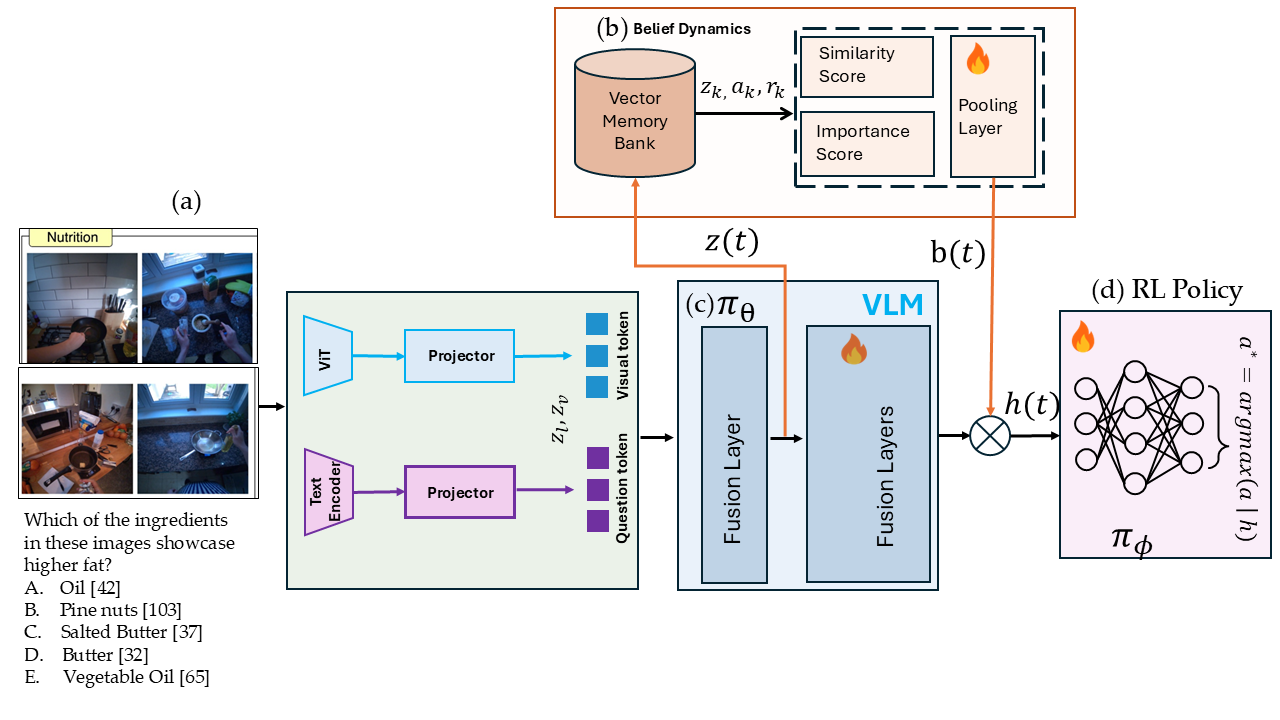
This work introduces a belief-aware vision-language model for intent inference in partially observable, long-horizon tasks. Retrieval-based multimodal memory approximates belief, while reinforcement learning over the model’s latent representation refines its decisions. Evaluation on video question-answering datasets demonstrates improvements over zero-shot baselines.
@article{nayak2026belief,title={Belief-Aware VLM Model for Human-like Reasoning},author={Nayak, Anshul and Shaik, Shahil and Wang, Yue},journal={arXiv preprint arXiv:2604.09686},year={2026},month=apr,}
arXiv
MA-VLCM: A Vision Language Critic Model for Value Estimation of Policies in Multi-Agent Team Settings
Shahil Shaik, Aditya Parameshwaran, Anshul Nayak, and 2 more authors
MA-VLCM replaces a learned centralized critic in multi-agent reinforcement learning with a pretrained vision-language model conditioned on task descriptions, visual trajectories, and structured team state. The approach improves sample efficiency and produces compact execution policies while supporting return estimation across in-distribution and out-of-distribution multi-agent scenarios.
@article{shaik2026mavlcm,title={{MA-VLCM}: A Vision Language Critic Model for Value Estimation of Policies in Multi-Agent Team Settings},author={Shaik, Shahil and Parameshwaran, Aditya and Nayak, Anshul and Smereka, Jonathon M. and Wang, Yue},journal={arXiv preprint arXiv:2603.15418},year={2026},month=mar,}
2025
arXiv
Prediction Uncertainty-Aware Planning Using Deep Ensembles and Trajectory Optimisation
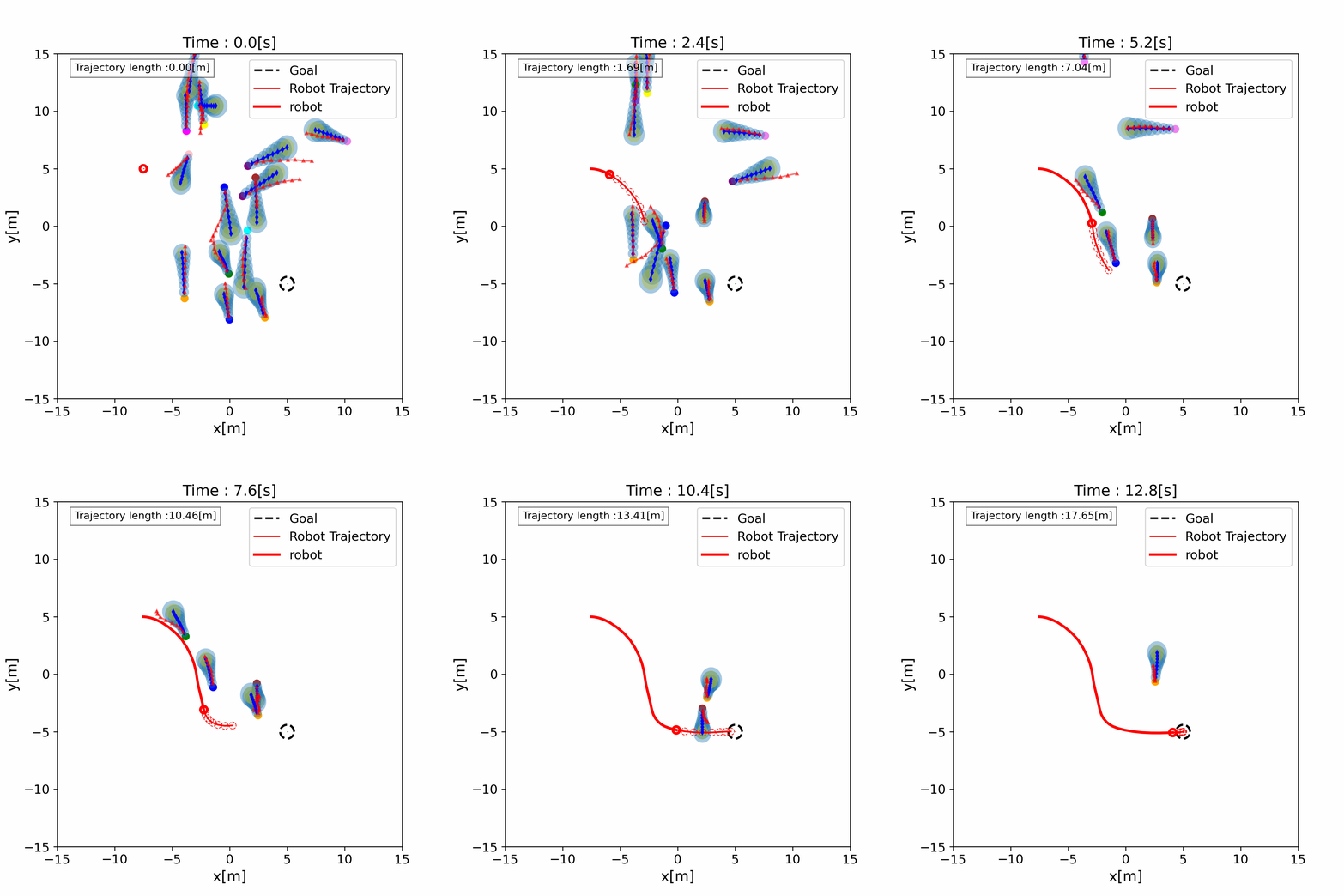
This paper integrates probabilistic human-trajectory forecasts from deep ensembles into robot motion planning. Predictive uncertainty is represented directly in planning constraints, with multiple constraint-satisfaction approaches evaluated on real pedestrian datasets and out-of-distribution corridor-navigation scenarios.
@article{nayak2025prediction,title={Prediction Uncertainty-Aware Planning Using Deep Ensembles and Trajectory Optimisation},author={Nayak, Anshul and Eskandarian, Azim},journal={arXiv preprint arXiv:2502.10585},year={2025},month=feb,}
2024
IEEE T-IV
Cooperative Probabilistic Trajectory Prediction Under Occlusion
Anshul Nayak and Azim Eskandarian
IEEE Transactions on Intelligent Vehicles, Oct 2024
An end-to-end cooperative perception framework recovers an occluded pedestrian’s current state in the ego agent’s reference frame and forecasts the pedestrian’s trajectory with uncertainty estimates. The method uses relative pose estimation between connected agents and supports uncertainty-aware navigation when direct sensing is obstructed or communication bandwidth is limited.
@article{nayak2024cooperative,title={Cooperative Probabilistic Trajectory Prediction Under Occlusion},author={Nayak, Anshul and Eskandarian, Azim},journal={IEEE Transactions on Intelligent Vehicles},volume={9},number={10},pages={6258--6269},year={2024},month=oct,doi={10.1109/TIV.2024.3365651},}
IEEE T-ITS
Pedestrian Trajectory Forecasting Using Deep Ensembles Under Sensing Uncertainty
Anshul Nayak, Azim Eskandarian, Zachary Doerzaph, and 1 more author
IEEE Transactions on Intelligent Transportation Systems, Sep 2024
This work presents an encoder-decoder deep ensemble that jointly captures upstream sensing uncertainty and predictive uncertainty in pedestrian trajectory forecasting. Comparisons with approximate Bayesian inference methods show that accounting for noisy perception improves estimation accuracy and produces more robust uncertainty-bounded forecasts, including for out-of-distribution trajectories.
@article{nayak2024pedestrian,title={Pedestrian Trajectory Forecasting Using Deep Ensembles Under Sensing Uncertainty},author={Nayak, Anshul and Eskandarian, Azim and Doerzaph, Zachary and Ghorai, Prasenjit},journal={IEEE Transactions on Intelligent Transportation Systems},volume={25},number={9},pages={11317--11329},year={2024},month=sep,doi={10.1109/TITS.2024.3382201},}
2023
IEEE ITS Mag.
X-CAR: An Experimental Vehicle Platform for Connected Autonomy Research
Goodarz Mehr, Prasenjit Ghorai, Ce Zhang, and 4 more authors
IEEE Intelligent Transportation Systems Magazine, Mar 2023
X-CAR is a full-scale experimental connected-autonomy platform built around affordable, high-quality hardware and the U.S. Department of Transportation’s CARMA software. Its sensing, communication, actuation, computation, mapping, and routing systems are designed to broaden access to connected driving automation research and simplify CARMA-based development.
@article{mehr2023xcar,title={{X-CAR}: An Experimental Vehicle Platform for Connected Autonomy Research},author={Mehr, Goodarz and Ghorai, Prasenjit and Zhang, Ce and Nayak, Anshul and Patel, Darshit and Sivashangaran, Shathushan and Eskandarian, Azim},journal={IEEE Intelligent Transportation Systems Magazine},volume={15},number={2},pages={41--57},year={2023},month=mar,doi={10.1109/MITS.2022.3168801},}
2022
IEEE OJ-ITS
Uncertainty Estimation of Pedestrian Future Trajectory Using Bayesian Approximation
Anshul Nayak, Azim Eskandarian, and Zachary Doerzaph
IEEE Open Journal of Intelligent Transportation Systems, 2022
This study applies Monte Carlo dropout during inference to standard neural-network forecasting architectures to estimate uncertainty in pedestrian future trajectories. Across multiple datasets, the probabilistic models improve displacement errors relative to deterministic baselines and reveal how dropout rate and forecast horizon affect predictive uncertainty.
@article{nayak2022uncertainty,title={Uncertainty Estimation of Pedestrian Future Trajectory Using Bayesian Approximation},author={Nayak, Anshul and Eskandarian, Azim and Doerzaph, Zachary},journal={IEEE Open Journal of Intelligent Transportation Systems},volume={3},pages={617--630},year={2022},doi={10.1109/OJITS.2022.3205504},}
2021
SAE IJ-CAV
Motion Planning of Autonomous Vehicles Under Dynamic Traffic Environment in Intersections Using Probabilistic Rapidly Exploring Random Tree
Xihui Wu, Anshul Nayak, and Azim Eskandarian
SAE International Journal of Connected and Automated Vehicles, Oct 2021
A Gaussian-process model predicts another vehicle’s future position at an unsignalized intersection and incorporates that prediction into the sampling and steering stages of rapidly exploring random-tree planning. Compared with standard RRT, the resulting probabilistic planner improves safe-path success rates and reduces execution time in simulated four-way-intersection scenarios.
@article{wu2021motion,title={Motion Planning of Autonomous Vehicles Under Dynamic Traffic Environment in Intersections Using Probabilistic Rapidly Exploring Random Tree},author={Wu, Xihui and Nayak, Anshul and Eskandarian, Azim},journal={SAE International Journal of Connected and Automated Vehicles},volume={4},number={4},pages={383--399},year={2021},month=oct,doi={10.4271/12-04-04-0029},}
ASME IMECE
Relative Pose Estimation for Cooperative Vehicles and Tracking of Multiple Dynamic Objects
Prasenjit Ghorai, Azim Eskandarian, Anshul Nayak, and 1 more author
In Proceedings of the ASME 2021 International Mechanical Engineering Congress and Exposition, Volume 7B: Dynamics, Vibration, and Control, Nov 2021
This paper develops an indirect relative-pose estimation method for cooperative automated vehicles using shared inertial-navigation positioning data. The method expands each vehicle’s effective field of view and combines cooperative perception with detection and tracking of pedestrians, bicyclists, and other vehicles in dynamic or partially occluded scenes.
@inproceedings{ghorai2021relative,title={Relative Pose Estimation for Cooperative Vehicles and Tracking of Multiple Dynamic Objects},author={Ghorai, Prasenjit and Eskandarian, Azim and Nayak, Anshul and Doerzaph, Zachary},booktitle={Proceedings of the ASME 2021 International Mechanical Engineering Congress and Exposition, Volume 7B: Dynamics, Vibration, and Control},series={IMECE2021},pages={V07BT07A017},year={2021},month=nov,doi={10.1115/IMECE2021-69651},}
2016
J. Manuf. Process.
Modelling, Simulation and Experimental Investigation for Generating ‘I’ Shaped Contour on Inconel 825 Using Electro Chemical Machining
The study models electrolyte flow, pressure, turbulence, and temperature during electrochemical machining of an ‘I’ shaped contour in Inconel 825. Computational-fluid-dynamics results are compared with experiments measuring material removal rate, surface roughness, and overcut, followed by grey relational optimization of electrolyte concentration, tool feed rate, and voltage.
@article{nayak2016modelling,title={Modelling, Simulation and Experimental Investigation for Generating ‘I’ Shaped Contour on Inconel 825 Using Electro Chemical Machining},author={Nayak, A. A. and Gangopadhyay, S. and Sahoo, D. K.},journal={Journal of Manufacturing Processes},volume={23},pages={269--277},year={2016},month=aug,doi={10.1016/j.jmapro.2016.05.001},}